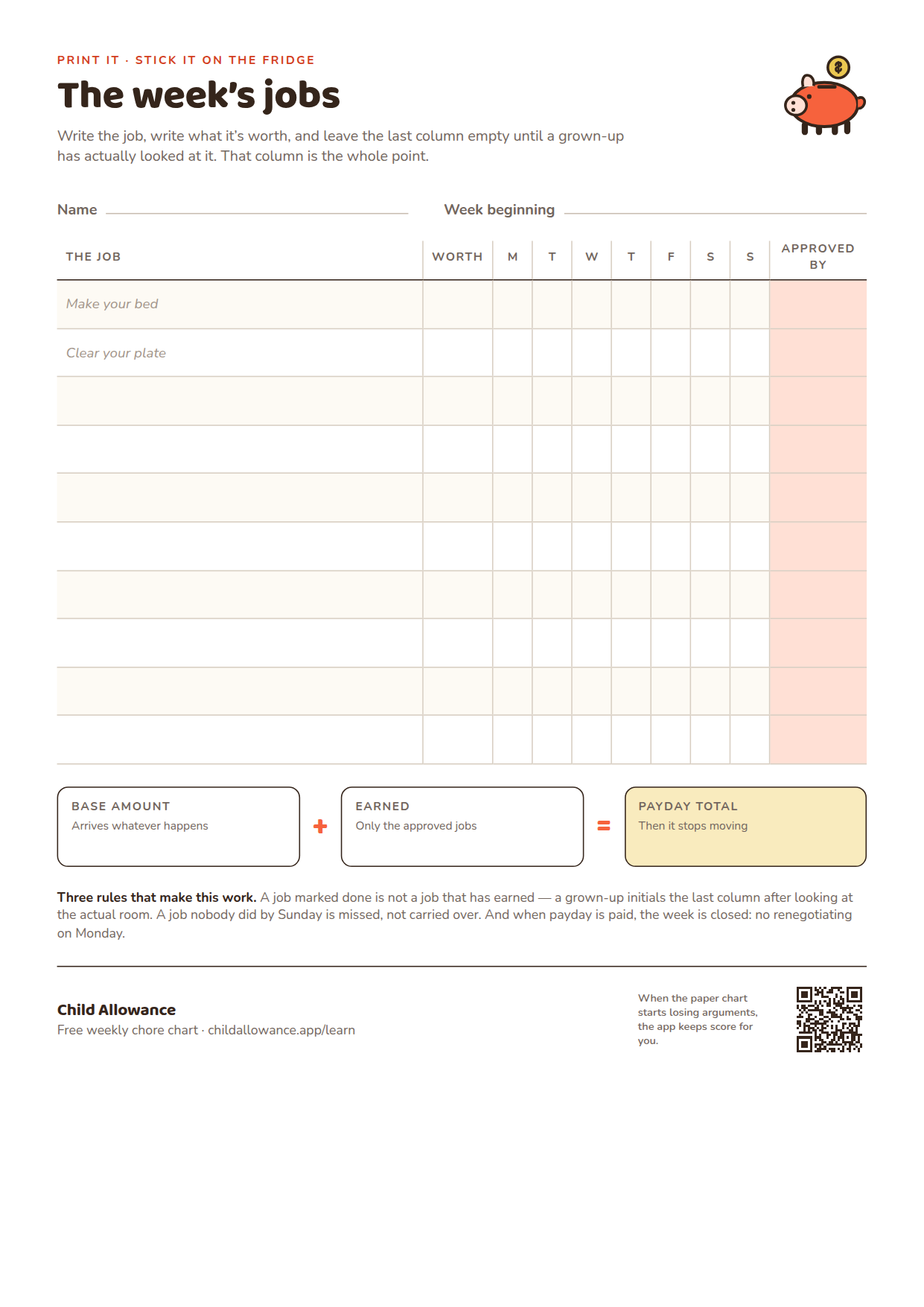
The sheet is a grid. Ten blank rows down the left for the jobs, a narrow Worth column beside them for what each one pays, seven day columns across, and a wider Approved by column at the right edge. The job rows are blank on purpose — a chart that arrives with someone else’s jobs already on it gets ignored by Wednesday, because nothing on it is yours.
Filling it in
Write the jobs in first, then the amounts, and do both before the week starts. Pricing a job while a child is standing over you wanting to do it is how a bin run ends up worth £3. Pricing it on a quiet Sunday takes ten seconds and holds all week.
Use four or five rows, not ten. The ten are there so one sheet suits a five-year-old and a twelve-year-old, not because anyone should fill them all. A child with five jobs does five jobs; a child with fifteen does two and feels bad about the rest.
Running the week with it
Put it somewhere it gets walked past — the fridge, the back of a kitchen door, the side of a cupboard at their eye level rather than yours. A chart in a folder is a chart nobody reads.
The child ticks the day column when the job is done. That tick is a claim, not a payment. The Approved by column is a grown-up’s initial, added after actually looking at the room, and it is the only mark on the sheet that releases money. Keeping those two marks separate is the entire mechanism: it means you never have to argue about whether something counts, because the sheet already distinguishes I did it from someone checked.
On payday, add up the Worth column against the approved ticks, out loud, in front of the chart. Then start a fresh sheet. A job nobody did is missed, not carried over — carried-over jobs pile up into a debt nobody can face, and the chart dies underneath it.
Printing it
A4 or US Letter, whichever your printer takes; both files are on this page and the grid is laid out for each rather than scaled to fit. Print at 100% — “fit to page” shrinks the writing rows to the point where a seven-year-old’s handwriting won’t sit in them.
It is designed to survive a mono printer, so there is no colour to run out of. If you would rather not print one a week, laminate a single copy and use a dry-wipe pen; the day columns are wide enough for a marker tip, which the amounts column deliberately isn’t.
When it stops working
Almost always one of two things. Either the jobs are wrong — too many, or one that was never finishable alone — in which case cut the list rather than adding a reward for completing it. Or the approval column stopped being used, which happens quietly and kills the chart within about a fortnight, because an unchecked chart pays out on unchecked claims and everyone can feel that it has stopped meaning anything.