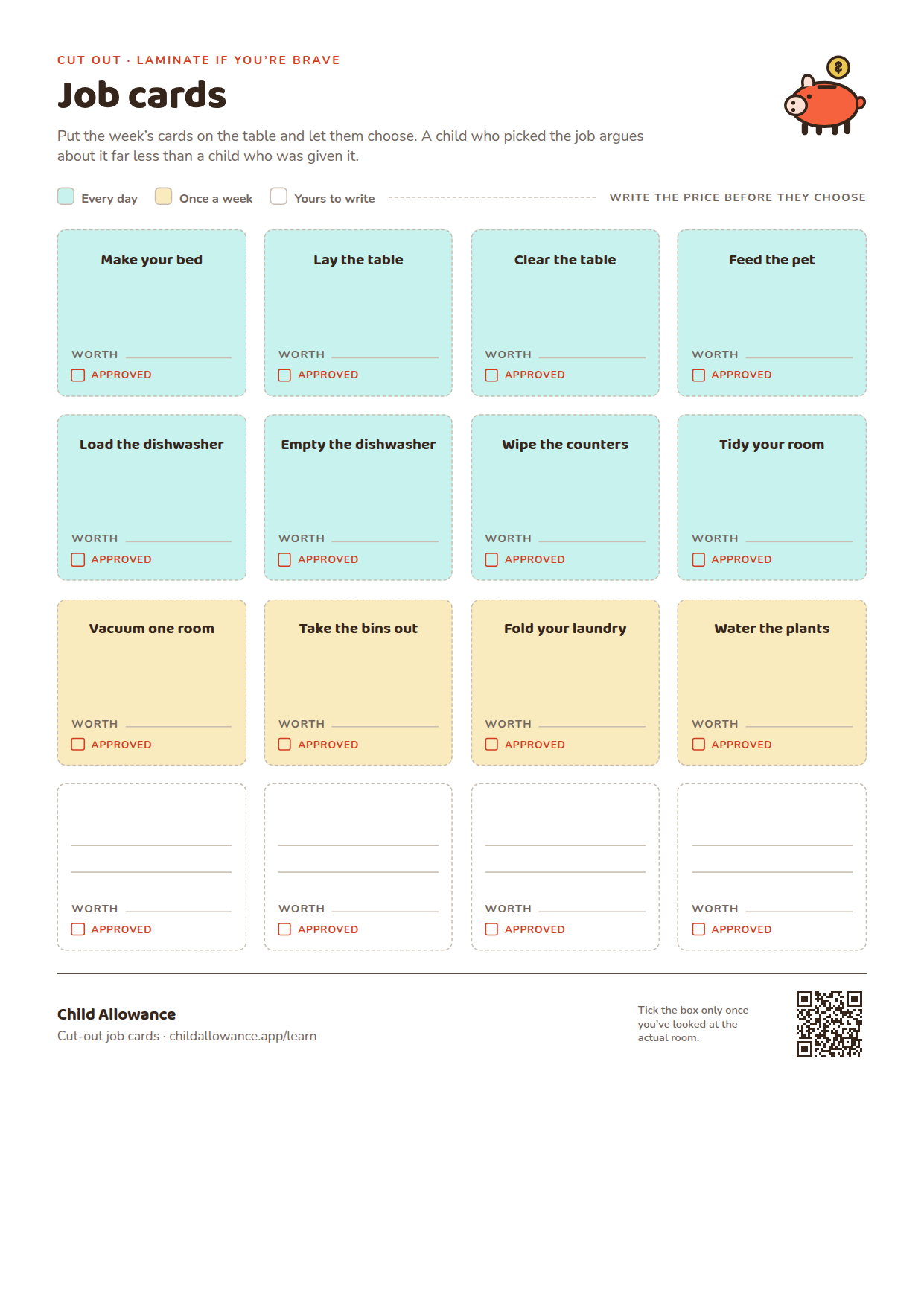
Sixteen cards on a cut-out grid. Twelve carry a common household job and a small picture, so a child who can’t read yet can still tell which card is which. Four are blank, for the jobs that only exist in your house. Every card has an empty box for what it pays and a tick box marked Approved.
Before you hand them out
Cut them out and write the amounts in first — all of them, before any child sees the pile. Pricing a card while someone is holding it and explaining why it’s very hard is how £1 becomes £4. Card stock or a quick laminate makes them last a term instead of a week; they get handled far more than a chart does.
Price by how much nobody wants to do it, not by how long it takes. Ten minutes of emptying the bins is worth more than ten minutes of watering plants, and children work this out immediately — a card priced purely by the clock is the one that gets argued about.
Running a week with them
Lay the cards face up on the table at the start of the week and let each child take the ones they want. Choosing is the point. A job a child picked off a table gets done with considerably less supervision than the identical job assigned to them, and with siblings it removes you from the negotiation entirely — the pile is finite and visible, so fairness is something they can see rather than something you have to adjudicate.
Leave the unchosen cards on the table. They stay available all week, which is what to point at when someone wants more money on Thursday.
Cards come back to you when the job is done. You tick Approved after looking at the actual result, not after being told about it, and the ticked cards are what you add up on payday.
Printing them
A4 and US Letter versions are both on this page, each laid out for its own paper rather than scaled. Print at 100% and use the heaviest paper your printer takes — on ordinary paper the cards go soft within days of being carried around in a pocket.
Mono printing is fine; the illustrations are line drawings. If you laminate, write the amounts with a dry-wipe pen so a price can be revised at the next review without reprinting the set.
If it stops working
The usual failure is cards that never come back — they end up in bedrooms, and the set quietly disappears. A named envelope or a clip per child, kept where the cards are laid out, fixes it. The other is one child taking every card: cap it at three or four each and leave the rest on the table.