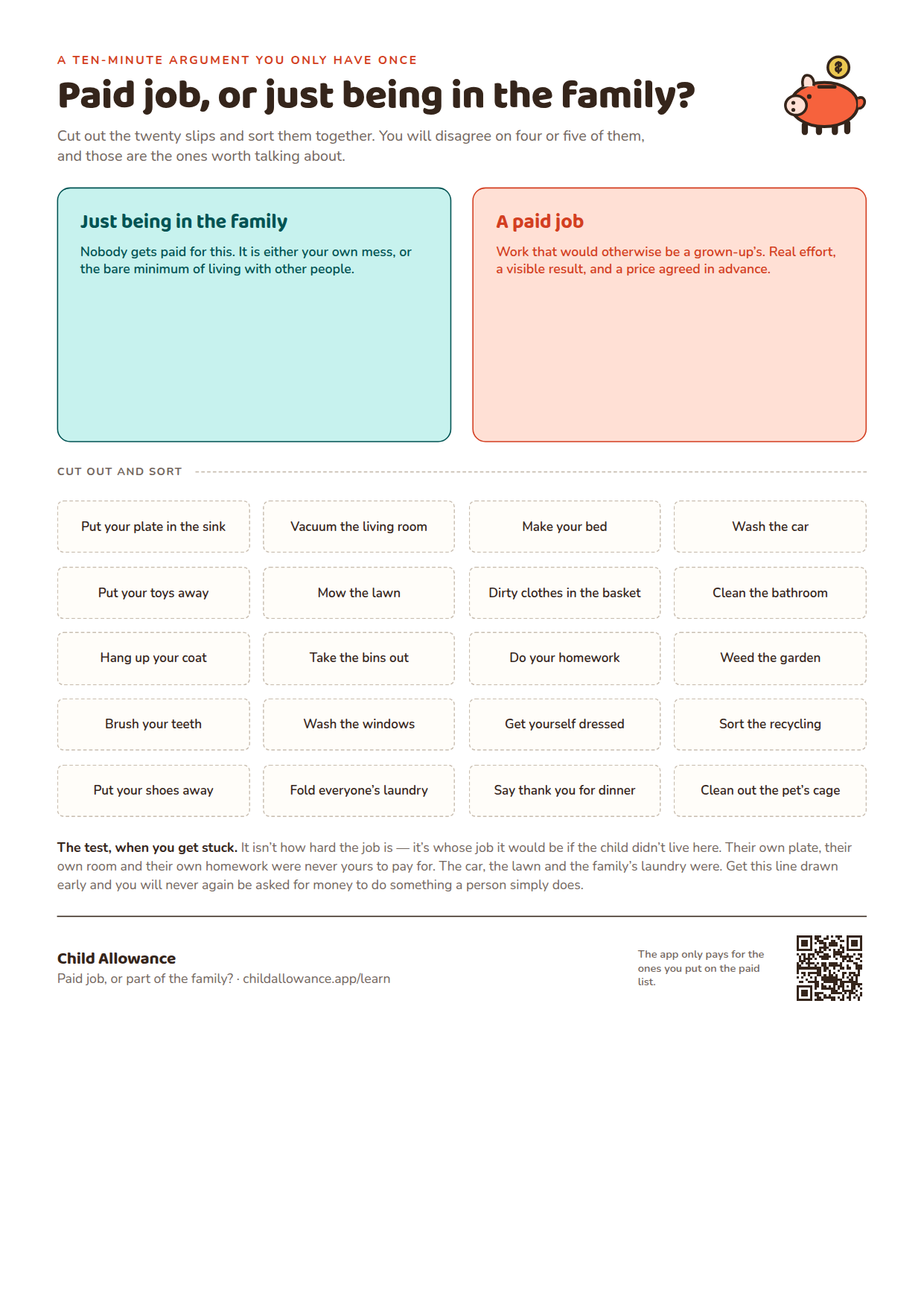
Two large boxes at the top — Expected, unpaid and Paid work — and below them a grid of twenty slips, each with one household job on it. Cut the slips out and the sheet becomes a ten-minute activity rather than a notice.
Doing the sort
Do it with the children, not for them. Hand over the slips one at a time and let them place each one. You keep a veto, and you will need it perhaps twice.
The question that unsticks almost every slip: whose job would this be if the child didn’t live here? If the answer is “it wouldn’t exist” — their own plate, their own washing, their own room — it belongs in the unpaid box. If an adult would still have to do it, it can be paid work.
Expect two or three genuine disagreements and let them run. A child arguing about which box a slip goes in is a child taking the categories seriously, which is the whole outcome you were after. It is also the last time you will have to have the argument, which is why ten minutes is a bargain.
After the sort
Stick the two piles down where they can be seen — inside a kitchen cupboard door works well, visible when you open it and invisible the rest of the time. The sheet’s value is almost entirely in being pointed at six months later, when someone asks to be paid for clearing their own plate and you can gesture at a box they helped fill in.
Leave the blank slips blank until a new job comes up, then write it and place it with the same question. A category that can absorb new cases is a rule; one that needs a fresh ruling each time is not.
Printing it
A4 and US Letter files are both on this page. Print at 100% — scaling to fit shrinks the cut lines and the slips stop lining up with the boxes. Ordinary paper is fine here, since the slips get handled once and then stuck down; card only helps if you plan to re-sort.
Two children who argue a lot are easier with two copies, one each, sorted separately and then compared. The disagreements between the two sheets are the conversation worth having.
If it doesn’t settle it
Usually one of two things went wrong. Either the sort happened without the child, in which case it is a ruling rather than a rule and carries none of the authority. Or the unpaid box has crept — if almost everything ended up paid, the line stops being principled and a child will reasonably test it again next month.