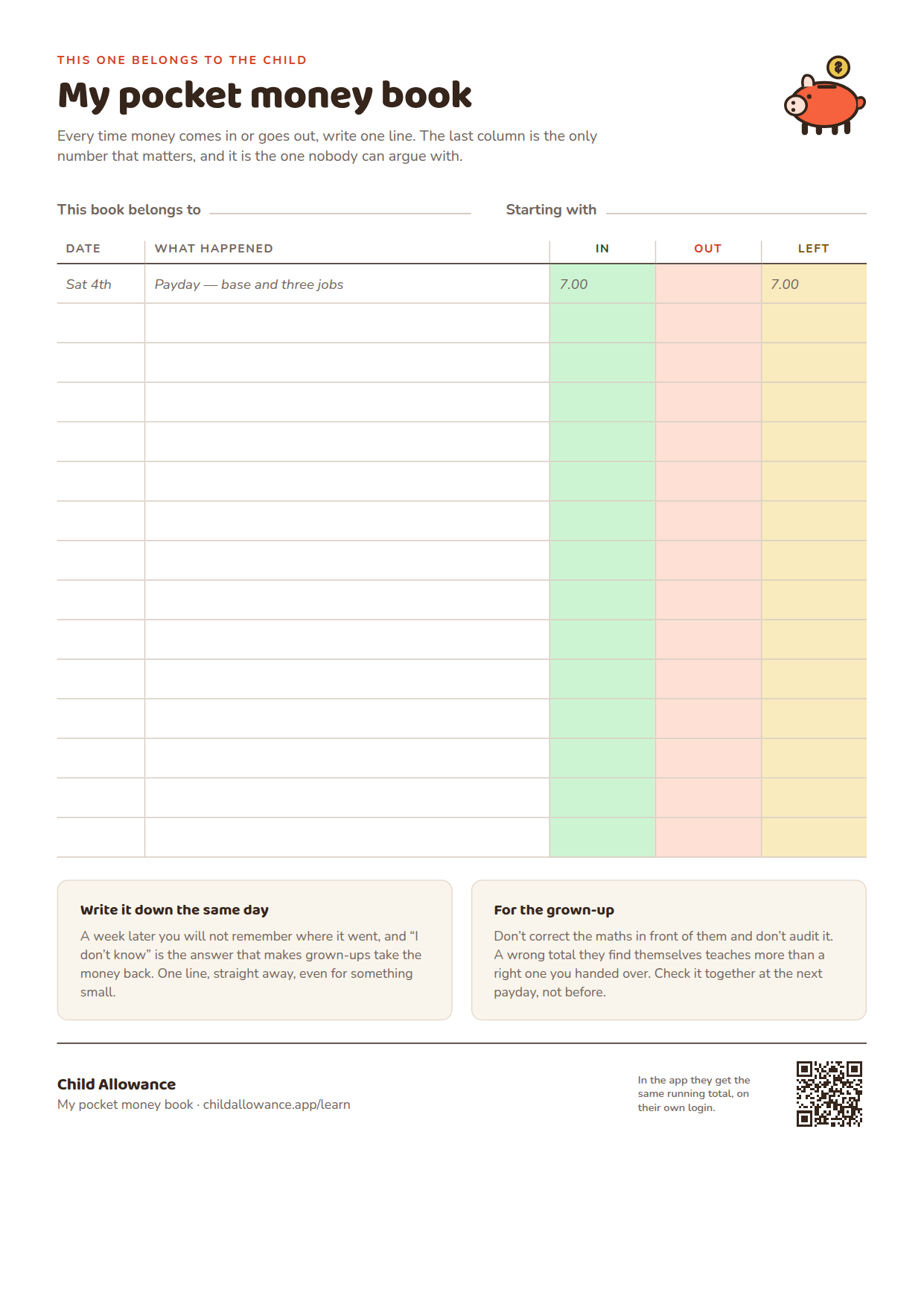
A name line at the top, a box for what they’re saving for and how much it costs, and then a ruled ledger: date, what happened, in, out, and a running total down the right-hand edge. About twenty lines, which is roughly two months at one allowance a week plus normal spending.
This is the only sheet in the pack written for the child rather than the adult. The handwriting on it should be theirs, including where it is wrong.
Handing it over
Write their name at the top and give it to them. Say, explicitly, that it is theirs and that you are not going to be keeping it up to date for them. A ledger a parent maintains is a bank statement, and nobody has ever learned anything from receiving one.
Fill in the goal box together, with the actual price of the actual thing. The running total column does its work by being compared against that number — the gap is what makes a child check the sheet between paydays rather than only on them.
Keeping it
One line each time money moves, written the same day. The habit is the skill here, not the arithmetic: a child who writes it down on Saturday and again on Tuesday is doing the thing that makes adult money legible, and doing it before the amounts are large enough to matter.
Keep it where the money is. If there are jars, the sheet lives beside the jars; if there is a tin, fold it into the tin. A ledger in a different room from the cash gets updated for about a week.
When the maths is wrong
It will be, and this is the part worth getting right. Don’t correct it over their shoulder. A sheet that gets red-penned stops being theirs and starts being homework, and it will be abandoned within a fortnight.
Look at it together at the next payday instead — add the column up side by side, find the line where it drifted, and fix it there. A child who finds their own error and repairs a running total has done something considerably more useful than getting it right first time.
Printing it
Both paper sizes are on this page. Print at 100%: “fit to page” narrows the ruled lines, and a nine-year-old’s handwriting needs the full height. Mono is fine.
Print two or three at once. When a sheet fills up, the last running total becomes the first line of the next one, and having the next copy already to hand is the difference between carrying on and quietly stopping.