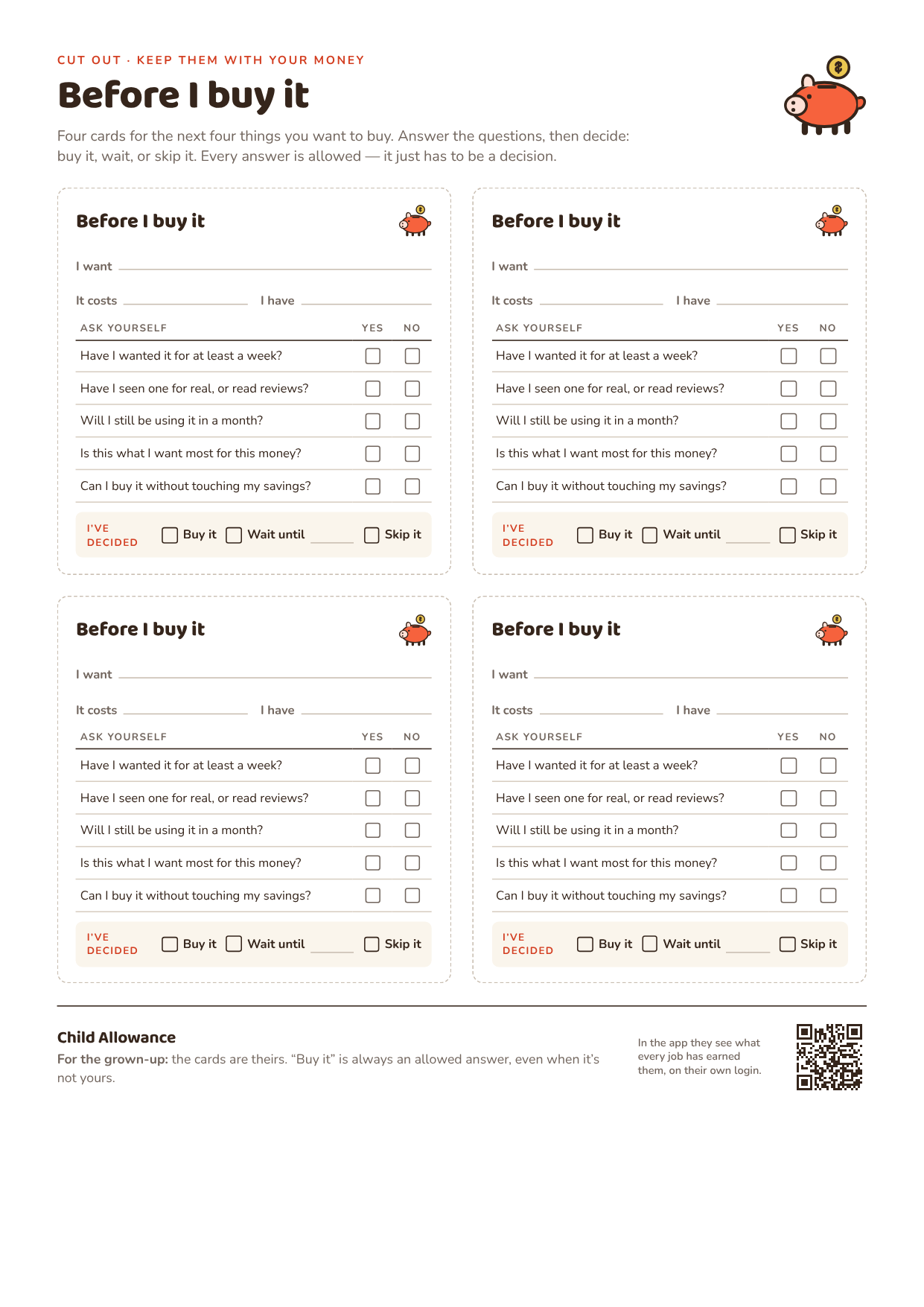
Four cards to a page, cut along the dashed lines. Each has lines for what they want, what it costs and what they have, then five yes-or-no questions: have they wanted it for a week, have they seen one for real or read reviews, will they still use it in a month, is it what they want most for this money, and can they buy it without touching their savings. At the bottom they tick a decision: buy it, wait until a date, or skip it.
There is no score. Five “no” answers and a tick in “buy it” is a perfectly good card. The point is that spending becomes a decision rather than a reflex.
When to bring the cards out
The moment a child asks to go and buy something with their own money is the moment for a card, not the moment to discuss whether it’s a good idea. Hand it over and let them fill it in. Anything under about £2 probably doesn’t need one. Anything that would take more than a couple of weeks’ money does.
They’re especially useful just after birthdays and Christmas, when a child suddenly has more money than usual and the first shop they pass gets most of it.
The “wait” pile
Keep the cards marked “wait until” somewhere both of you can see, and look at them again on the date. Most children find that about half the things they were desperate for a week ago have quietly stopped mattering. Nobody needed to say so; the card did it.
The ones that do survive the wait are worth taking seriously. A thing still wanted after a week is often a good candidate for a proper savings goal.
What the card is not
It isn’t a permission slip. If the card becomes a form the child fills in to get your approval, it stops working and starts being argued with. Fill one in yourself sometimes, out loud, for something you want. They copy the habit far more readily than the rule.
Printing it
Both paper sizes are on this page. Print at 100% so the tickboxes stay a usable size. Mono is fine. Thicker paper or card makes them last longer in a coat pocket.